Do social media ads work?
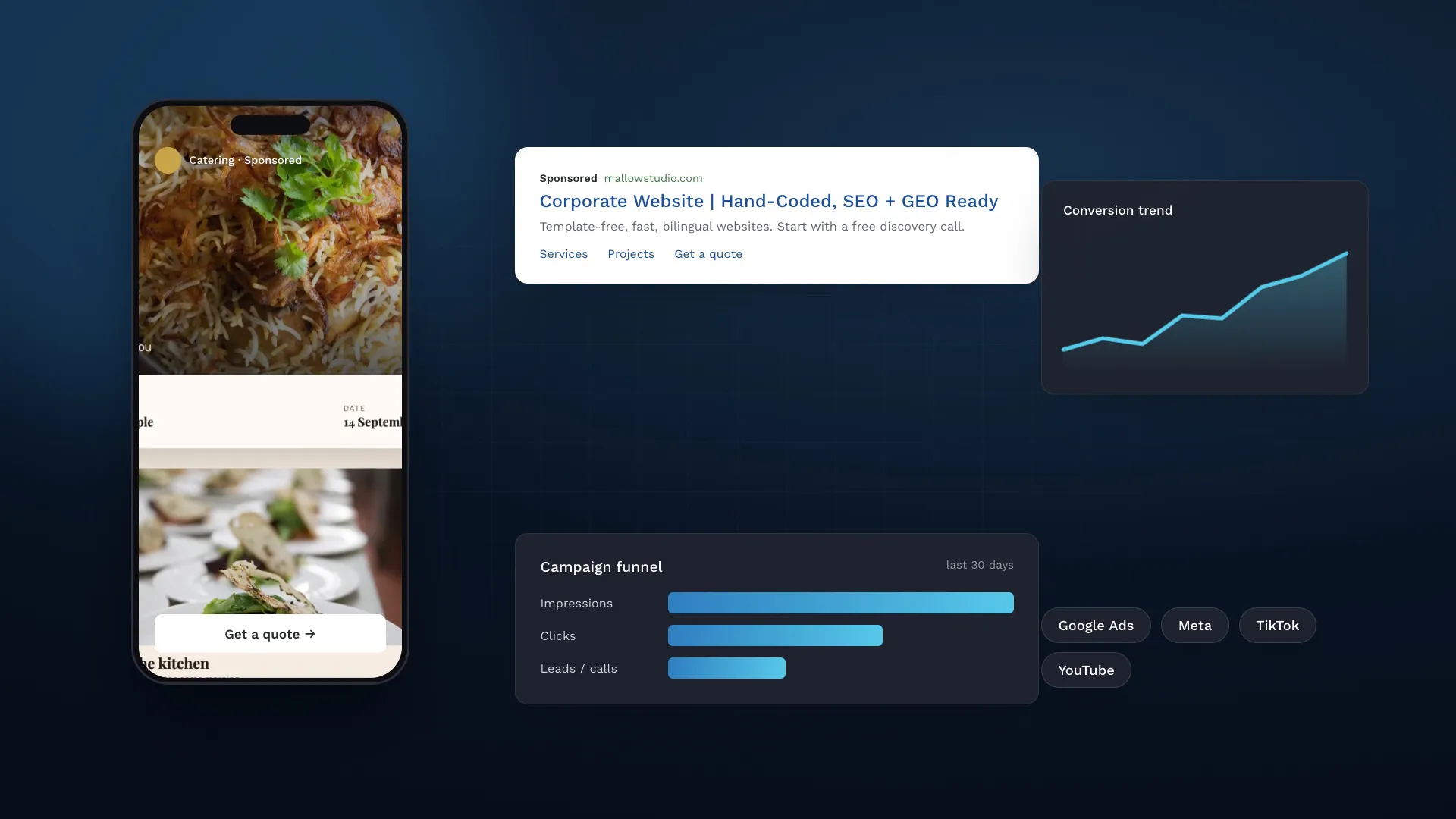
Social media ads work well for products that can be shown visually, decided on quickly and priced within reach. In long-cycle B2B they are a demand-collection and awareness tool rather than a direct sales channel. Success is measured by cost per click, conversion rate and customer acquisition cost — not likes. Budget spent without measurement produces no learning.
- Measurement first, budget second
- Products you can show sell more easily
- In B2B the goal is leads, not instant sales
- Judge acquisition cost, not likes
Who do social ads actually work for?
The honest answer isn't "everyone". In our experience ads work clearly when three things line up: the product can be shown visually, the decision is quick, and the price is one someone can commit to in a single step. Food, retail, personal care and events fit that description.
For long-cycle, high-value work — industrial sourcing, enterprise software, consulting — entering with the same expectation leads to disappointment. There, the ad's job isn't to close a sale but to collect demand and build recognition; a person closes the sale later.
How much budget do you need?
There's no fixed figure, but the logic is simple: you need enough data to learn. An ad set usually needs several hundred clicks before its result means anything. If your cost per click is €0.40, testing a single variant is a few hundred euros.
That's why splitting a small budget across many variants is the most common mistake: no set gathers enough data, and all of them look like failures. Starting with few variants teaches you faster.
Which metric actually matters?
| Metric | What it tells you | Enough alone? |
|---|---|---|
| Likes / reach | How many saw it | No |
| Click-through rate | Whether the creative interests people | No |
| Conversion rate | Whether visitors act | Partly |
| Customer acquisition cost | What a customer costs you | Yes |
Only the last row speaks in profit and loss. But revenue isn't profit: if a customer costs €30 to acquire and orders €90 on average, the number that matters is the contribution margin left after product, shipping, returns and payment costs. The ads work when that margin covers the acquisition cost and the payback period suits your cash flow. These figures are an illustrative assumption.
Don't advertise before measurement exists
Before spending, three things must be in place: which action counts as a conversion (form, call, order), technical tracking for that action, and a record of where the traffic came from. Without them, the money is just an expense — it produces no learning.
Ads or SEO?
They aren't rivals, they're different time scales. Ads bring demand today but stop when the money stops; SEO and GEO build slowly but last and lower costs over time. The healthy setup is usually: learn fast with ads, then move the message that worked into lasting content.
Four common mistakes
- Starting without measurement. You can't see results, so you conclude there aren't any.
- Splitting the budget too thin. No set collects enough data to learn from.
- Great ad, poor landing page. If the click lands on a slow, unclear page, the budget disappears at the door.
- Giving up too early. The first week is usually a learning week.
Ads won't rescue a poor product or a poor page; they make a good one known faster.
Frequently asked questions
Which platform should we advertise on?
Wherever your customers are. Instagram and TikTok suit visual, younger audiences; LinkedIn and search ads work better in B2B where you need decision-makers. We usually suggest starting on one platform and expanding with data.
How long until we see results?
First meaningful signals usually appear within one to two weeks, and a sound decision needs a few hundred clicks of data. In long-cycle businesses the sale itself may take months.
Does everything stop when ads stop?
The paid traffic from those campaigns stops, yes — that is a different channel from direct traffic in your analytics. It's why demand collected through ads should feed lasting channels like an email list, content and SEO.
Can we start with a small budget?
You can, but set expectations accordingly: a small budget is enough to test one message, not five ideas at once.