Hand-coded website or WordPress?
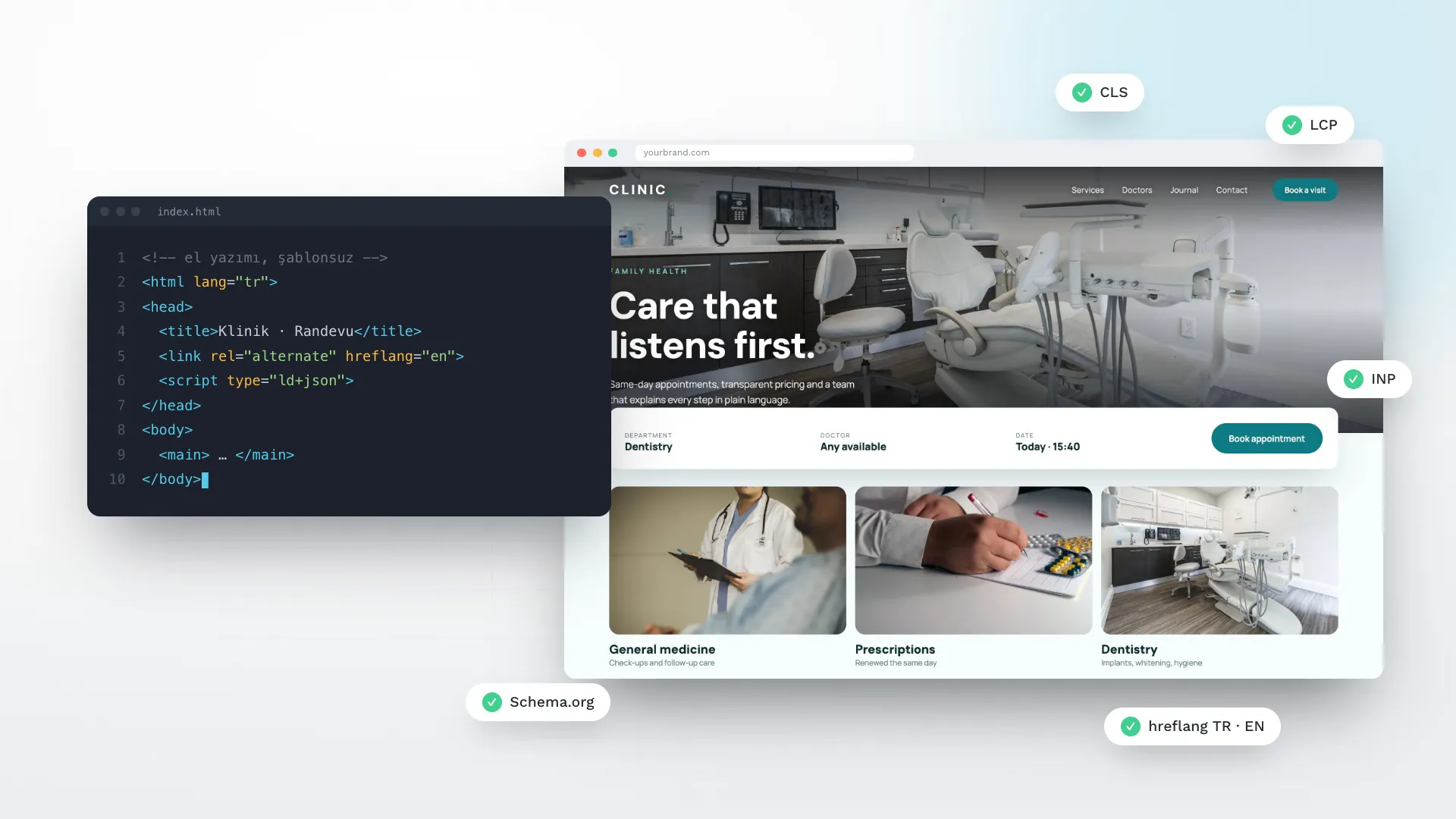
WordPress is still a good option for businesses that publish content often, need its broad plugin ecosystem and have no technical team. A hand-coded site is better when speed, security and longevity come first: it contains only the code it needs, requires no plugin updates and usually scores better on Core Web Vitals. If you need content management, a headless CMS such as Payload combines the advantages of both.
- Speed and security → hand-coded
- Frequent content + plugin needs → WordPress
- In between: Next.js + headless CMS
- Decide on five years of maintenance
The short answer
WordPress is the world's most widely used content management system, and its huge plugin ecosystem lets even non-technical people build a site quickly. A hand-coded site is one where everything needed is written by hand, without an off-the-shelf theme or page builder. They serve different needs.
Comparison
| Criterion | WordPress (theme + plugins) | Hand-coded |
|---|---|---|
| Speed | Depends on theme and plugins; tends to slow over time | Only the code needed; usually very fast |
| Security | Core, theme and plugin updates need constant attention | With no database or plugins, a very small attack surface |
| Content management | A ready, familiar dashboard | A headless CMS added when needed |
| Design freedom | Within the theme's limits | Unlimited |
| Upfront cost | Can be low | Design + development fee |
| Maintenance | Regular updates and compatibility checks | Minimal |
| Hosting | Needs PHP + a database | Static hosting or a CDN is enough |
When is WordPress still the right choice?
- A blog or news site with an editorial team publishing several times a week.
- A standard need that a particular plugin (e.g. bookings, memberships) handles very well.
- When the site must be run entirely by your own team without technical support.
When is a hand-coded site better?
- Corporate sites, product catalogues and service sites with a clear structure whose content changes a few times a month.
- When speed and Core Web Vitals are critical to ad and SEO performance.
- When a multilingual structure (hreflang, language-specific URLs) has to be flawless.
- When you want to minimise security and maintenance work.
The middle ground: Next.js + a headless CMS
If you want easy content editing without carrying WordPress's weight, coding the front end in Next.js and managing content from a headless CMS such as Payload is a good middle path. We did exactly that when migrating a robotics company's site: we moved the Elementor-built site to Next.js + Payload CMS while keeping its look and URLs identical, and the team now edits section by section from a Turkish admin panel.
Four questions to ask before deciding
- How often will content change, and who will change it?
- How critical is speed to your ad and SEO performance?
- Who will handle updates and security maintenance over the next five years?
- Is the site multilingual, or will it be?
Frequently asked questions
Can we edit content ourselves on a hand-coded site?
Yes; if content changes often, a headless CMS is added so you can edit from a dashboard. On sites that rarely change, updates take a developer a few minutes.
Can you move my WordPress site to a coded stack?
Yes. We migrate pages, images and URLs as they are and set 301 redirects where needed. That reduces migration risk; rankings may still fluctuate during the move, so we monitor indexing and organic traffic after launch.
Is a hand-coded site better for SEO?
Not by itself — but because it makes speed, clean HTML, a correct multilingual structure and structured data easy to get right, it gives SEO and GEO work a solid foundation.