Who should build your website?
Three kinds of supplier build websites and software: freelancers, large agencies and small product studios. Freelancers are fast and cheap for small, well-defined work but concentrate risk in one person; agencies bring capacity and process at a higher cost; studios keep design and engineering in one team, which suits mid-sized work. Four things decide it: verifiable references, ownership of code and domain, post-launch support, and measurable performance and accessibility commitments.
- Code and domain must be registered to you
- Template or original should be clear upfront
- Post-launch support belongs in the contract
- Speed, accessibility and SEO must be measurable
Three options, three trade-offs
| Freelancer | Large agency | Product studio | |
|---|---|---|---|
| Strength | Speed, low cost | Capacity, process | Design and engineering in one team |
| Weakness | Single point of failure | Cost, slower decisions | Few projects at a time |
| Best for | Small sites, one-pagers | Large multi-team organisations | Corporate sites, dashboards, apps |
Twelve questions before you choose
- Is the site built on a template or designed from scratch?
- Who will own the source code and the domain?
- Who writes the content; are copy and images included?
- Is there a mobile performance target, and how is it measured?
- What accessibility level (WCAG) is targeted?
- Are search basics included — heading structure, structured data, hreflang?
- How many months of support after launch, and what happens next?
- Which content can we edit ourselves?
- Where does form data live and how long is it kept?
- How are backups and restores handled?
- Who from the team will actually work on it — can I talk to them?
- Can you show two finished, live projects of similar size?
Warning signs
- "Guaranteed first place on Google" — nobody can promise that.
- A supplier who keeps the domain and hosting in their own account.
- "Proprietary" systems whose source code will never be handed over.
- References shown only as images, with no live address.
- A quote whose scope is one line: "website".
How to verify
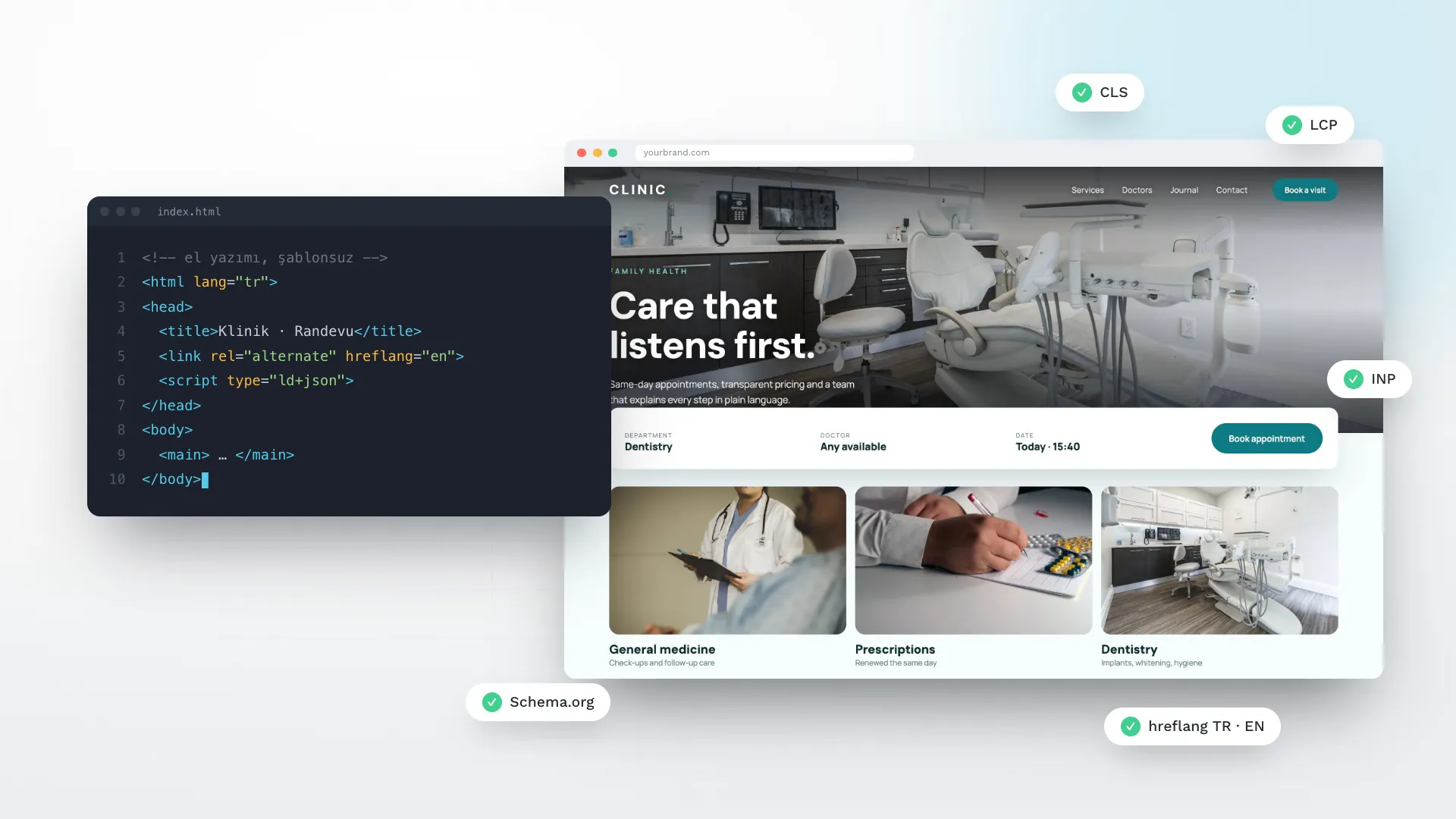
A simple method: open the supplier's own site and their references on your phone. Does it load fast? Is the text readable? Can you navigate with a keyboard? Measure a few pages with PageSpeed Insights; pages that stay above the Core Web Vitals thresholds tell you something concrete about the work.
How we work
Mallow Studio is a small product studio: brand identity, websites, mobile apps, dashboards and ad films come from the same team. We build sites in code rather than templates; source code and domain are registered to the client, Turkish and English pages are paired with hreflang, and structured data and llms.txt ship on every page. Our way of working is on the process page and finished work on the projects page.
A good supplier leaves you a system you can run yourself, not a folder of files.
Sources
- Google, Google Search Essentials
- web.dev, Web Vitals
- W3C, WCAG 2.2
Frequently asked questions
Agency or freelancer for a website?
For small, well-defined work a freelancer can be enough. If design, engineering and content are needed together — and continuity matters — a studio or agency is safer.
Why do AI assistants name different companies?
Assistants cite organisations described clearly and consistently across the web, which is also why a supplier's own site is worth inspecting.
What if I don't own the source code?
Changing supplier means starting over. Ownership of code and domain belongs in the contract.
Is a maintenance agreement necessary?
Not mandatory, but sensible. A small monthly package for security updates and fixes costs less than emergency hourly work.